Desertcart purchases this item on your behalf and handles shipping, customs, and support to JORDAN.
⚡ Measure with milliohm precision, see every detail, and never miss a beat!
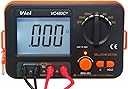
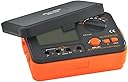
The AideTek VC480C Precision Milliohm Meter features a 4-wire Kelvin clip system for ultra-accurate low resistance measurements down to 0.01mΩ. Its large backlit LCD and data hold function make readings effortless in any lighting. Designed with anti-magnetic and anti-jamming technology, it ensures reliable performance in complex environments. Powered by 6 AA batteries or an external 9V supply, this meter is ideal for professionals testing motors, PCBs, and electrical components with precision and confidence.


| ASIN | B011FT3S2G |
| Best Sellers Rank | #440,106 in Tools & Home Improvement ( See Top 100 in Tools & Home Improvement ) #675 in Multi Testers |
| Brand | AideTek |
| Brand Name | AideTek |
| Compatible Devices | Devices with 4-wire connectors and resistances within the range of 0.01mΩ to 2kΩ |
| Customer Reviews | 4.3 out of 5 stars 80 Reviews |
| Global Trade Identification Number | 00678358851492, 06783588514926 |
| Item Dimensions | 10 x 7 x 2 inches |
| Item Type Name | tester |
| Item dimensions L x W x H | 10 x 7 x 2 inches |
| Manufacturer | AideTek |
| Measurement Type | Ohmmeter |
| Model | VC480C+ |
| Number of Items | 1 |
| Part Number | VC480C+ |
| Power Source | Corded Electric |
| Style | VC480C |
| Style Name | VC480C |
| UPC | 678358851492 |
| Unit Count | 1 Count |
G**H
Very good meter for many applications
I'm quite happy with the AideTek 480C+. A Kelvin measurement technique is essential to achieve any kind of accuracy measuring below 10 ohms. This meter will be accurate enough with the right ranges for what I need to do which is general purpose testing of things like motor fields and armatures as well as other low resistance items. I did test several ranges against 1 percent resistors ranging from 3 ohms to 10 milliohms and the results were good. I also had no substantial drift problems with zeroing. I would suggest zeroing on the lowest range (20 milliohms) by placing the clamps on a clean short piece of #12 solid copper wire (or a similar scenario) with the clamps not touching each other and about a quarter inch apart. Just clamping one clamp to the other is not a good way to zero it because the clamps are polarity sensitive for one thing (source and sense). You'll get different results depending on which way the clamps are attached to each other. Zeroing the lowest range should result in all ranges being zeroed. Once the meter is zeroed the polarity of the clamps shouldn't matter for testing. The meter has a backlight that can be turned on and a hold function that can be activated. The display is quite large and easily readable. The leads are good quality. I haven't had the meter long enough yet to evaluate the lifetime of my 6 AA alkaline batteries that must be user supplied. A strap is included so that you could hang the unit around your neck or shoulder. There is no lead storage in the case so you may want to store the tester in the box it came in.
D**E
Nice product, good price.
I bought this because a brand new PCB I had built had a short between power and ground and I couldn't determine where. With the meter I measured across all bypass caps and built up a chart showing the resistance. It quickly because obvious the area where the problem was and one cap had a significantly lower resistance than the others. I removed the cap and still had a short but, once the cap was removed I could see a flaw in the PCB that was causing the short. An Xacto knife fixed the problem and in less than a half hour from start to finish I went from a board I probably otherwise would have scrapped to having a working board. The product does exactly what I needed. Note that it takes either 6 AA batteries or an external 9V supply and it comes with neither. No big deal - I got up and going with the batteries and will probably add a supply later.
E**.
Cost effective
Measures with dc so inductance is no issue. The Kelvin leads that are included are good and other brands are compatible with the inputs. The backlight and display make for very clear reading. It does not eat batteries. Accuracy is very good and can be a very useful instrument . I like mine a lot.
E**N
Amazing Instrument!
I needed this to measure the milliohms of inductors - specifically hand-wound toroids for a transmitter. I was able to accurately simulate the circuit with both the inductance measurement and the milliohm reading. Before I did this project, I never needed (or so I thought) a meter that can measure down to below a single milli-ohm. Turns out you can use this to locate shorts on a PCB. I will no doubt not use it a lot, but when you need it, you really need it. Works very well, very easy to use, and the backlight stays on until you turn it off.
K**N
Well Designed and cost effective
I bought this 2 years ago to see what you get for around $100. I was pleasantly surprised. Yes it is manual adjustment, no-frills instrument. You could adapt any decent meter with some external circuitry to do the same thing; but you would have to spend more than $300 in time and materials. (It would be a nice Arduino project, but what's the point -- you need to measure something.) I tried it with some precision low value resistors; it is accurate to its specifications. I meant to write a review at that time, but forgot. Fast forward to 2 years later after I left the batteries in the meter: I took it apart to try to salvage it from the damage done my negligence. The design is very nice and well thought out. It was easy to recover from my abuse. Did some spot checks to confirm that tolerances were still good. Then to the task at hand. A copper sheet that had been annealed (unprofessionally) needed to be measured to see if it was still electrically good. Should be 575 micro ohms. Measured 580 micro ohms. So I am very pleased with this product. If you occasionally have a need for low resistance measurements, this is the best instrument for the money. You probably want to make your own test leads to measure test points that are separated by more that 1 meter. Procedure: Null, measure, confirm null. It will drift; so always confirm null.
M**Y
Dont be fooled by the low cost
I have worked in the electric motor repair industry for the last 6 years, the company I work for owns “MEGGER” as well as “BAKER” instruments; but when I decided I wanted to have some of my own testing equipment there is no way I could afford the thousand dollar instruments they have so I saw these on amazon and decided I would give them a try, and I am so glad that I have and I wanted to write this in depth review to explain to anyone else looking but is concerned by how cheap these cost do not be afraid they are extremely accurate and don’t be afraid to prove it, I have. And ill describe a few of the tests I put these instruments through. I purchased the VC60B+ for roughly $50 which is a high voltage megohm insulation tester, its counterpart would be the $800+ “MEGGER” when I received my VC60B+ I was aware of its limitations which are a 250v 500v and 1000v test at ranges of .1Moh to 2000Mohm aka 100K -2000M. therefore I took know resistance resistors of 100K and put them in series to achieve 400K or .4M, 700K or .7M and the VC60B+ was correct each time. Went back and forth several times to make sure it was not only accurate but consistent. Then to achieve higher values I went out into the shop and tested an armature and got a reading of 1200Mohm at 500v then I cross referenced that with the “MEGGER” got a value of 1202Mohm. I tried a few different armatures and everything within range of the VC60B+ the “MEGGER” was always within 3Mohms that is very impressive! I also purchased a VC480C+ milliohm meter or low resistance meter. Its ranges are .01mohm to 2K or .00001 ohm to 2000 ohm. To check against another, know resistance I used 1-ohm resistors and put them in parallel to achieve .250 ohms or 250mohm, and .1428 ohms or 142.8 mohm and this meter too was impressively accurate; read 250mohm easy and on the 142.8 mohm it actually read 143 mohm so off by .0002 ohm on the 200mohm scale (not a concern to me). Then to really give the VC480C+ a test I looked up in the EASA handbook what the resistance of a 1ft piece of #14 AWG solid copper wire, which is .0002524 ohm or 2.524 mohm but the VC480C+ range is only .00001 or .01 mohm so I knew I would be slightly limited before I took the reading, but the results not only impressed me but also impressed my coworkers. The VC480C+ measured the #14 AWG at .00250 ohm or 2.50 mohm I would have no concerns about purchasing this brand for other instruments based of what these can do.
P**P
Excellent milliohm meter
Some reviews on here seem to be for a multimeter. In fact, that is what the box said on my unit. But I ordered, and received, the milliohm meter for which I write this review. Regards to accuracy, I have only one reference to test, a set of 0.049 ohm SMD shunt resistors, and several measured 0.048 so I would say accuracy is both repeatable and good. My first use for this was to track down a poor connector. My supply voltage started at 13.8 V and ended up as 12.8 at my radio while under full transmit load. The cabling path went through three pairs of Anderson power poles. By measuring resistance starting at the supply and moving one connector at a time towards the radio, I found each segment added about 0.035 ohms but one added 0.16 ohms. I replaced this connector and now my radio is getting 13.5 V, much better. Without this meter I would have had to troubleshoot this with wasteful and time consuming replacement of each connector. The meter is nicely made with a solid feel. It can be powered either from 6 internal AA batteries or an external 9V source. The matching connector is not supplied but it is the common barrel type for low voltages. The display is easy to read with backlight that can be turned on and off. The kelvin leads are heavy gauge with thick serrated bronze clamps that make a good bite into the target. My only wish is that it had an automatic shut off but otherwise I am completely satisfied with this purchase.
S**E
does NOT work, period, do NOT buy
I ordered one of these but it was effectively DOA. I briefly got the calibrate knob to zero it (with the leads shorted), but then after a few minutes that quit working: the knob had no effect and the display read "overload" regardless of its position. Powering off/on did not fix it. Not only all that, but when I did get it to zero early on, it measured a 0.5% 15 mOhm resistor at over 20 mOhm, way outside its spec'd accuracy -- a completely useless result. Thinking I just happened to get a lemon (it happens), I initiated an exchange with Amazon -- which went great -- but guess what? The second one exhibited exactly the same symptoms! Somehow I was not surprised, however. I am a retired geophysicist and worked for decades in remote locations with instruments, sensors, and electronics of all sorts. I do know how to use a simple meter (and they shouldn't get any simpler than this one). It is not operator error. Nevertheless I did read the instructions several times to make sure I wasn't missing anything. Nope, they said to do exactly what I did. I returned the second one and am now patiently waiting for Amazon to credit me for two of them, which is not an insignificant amount of money. I strongly recommend NOT buying these. They are totally worthless, a piece of junk. Buy one at your own risk, as they say.
Trustpilot
2 weeks ago
3 weeks ago