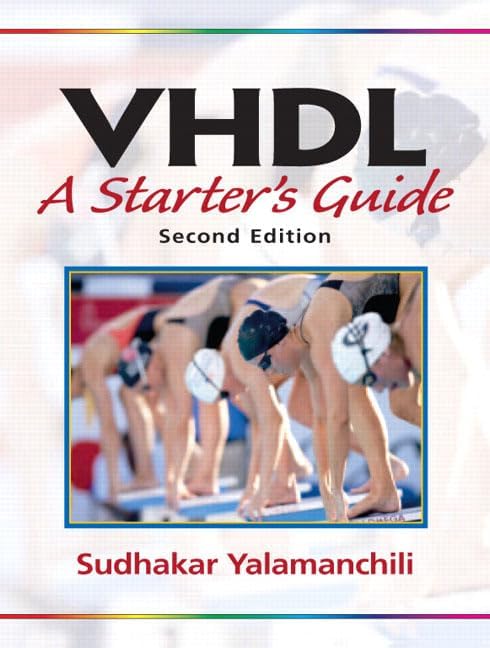
VHDL: A Starter's Guide (2nd Edition)
Product ID: 14645840
Desertcart purchases this item on your behalf and handles shipping, customs, and support to JORDAN.
This handy reference gives readers a thorough grounding in the basic concepts and language of VHDL, and encourages them to apply what they have learned using realistic examples. Concepts are followed by examples and tutorials. Adds appendices to support material: Includes a tutorial for a popular VHDL simulator; a handy reference to common VHDL packages; and a detailed template for a VHDL model illustrating the relative ordering of program constructs. Emphasizes development of readers’ intuition and structured thinking about VHDL models without spending excessive time on advanced language features. Provides simulation and laboratory exercises that enable readers to quickly come up to speed in building useful, non-trivial models of digital systems. Provides tutorial descriptions and presentation of programming mechanics unique to CAD tools and environments. Includes examples, extensive use of timing diagrams, event lists and many tutorials for independent student study. Provides sample problems, many of which include worked solutions. Includes viewgraph masters and the VHDL source for all text examples. A useful reference for computer professionals who need to brush up on their VHDL knowledge. Review: Needed it for class - Never even opened it (I opened it, but barely used it) Did well in the class without it. One thing to mention is that this is not a reference book. It is written more as a VHDL tutorial and good for beginners. Review: straightforward language to learn - VHDL is a rather specialised programming language. It has subroutines, loops, if statements and other characteristics of general purpose procedural languages. But this book goes on to show that VHDL has very specific attributes that let you (hopefully easily) model circuits. These circuits might be combinatorial or sequential. For the latter, the book also goes into how this segues naturally into the idea of a finite state machine. A key concept in circuit design, and one that you need to master. To aid you, the book explains how you can build a behavioural model of a FSM. The theory of FSMs is not really expounded to any depth. An emphasis in this book is on using VHDL to model. You should note that VHDL is not an object oriented language. Though a minor aspect, that of being able to overload a subprogram name, seems to borrow from those languages.
| Best Sellers Rank | #2,468,496 in Books ( See Top 100 in Books ) #202 in Computer Programming Logic #4,458 in Computer Programming Languages |
| Customer Reviews | 4.2 out of 5 stars 7 Reviews |
C**.
Needed it for class
Never even opened it (I opened it, but barely used it) Did well in the class without it. One thing to mention is that this is not a reference book. It is written more as a VHDL tutorial and good for beginners.
W**E
straightforward language to learn
VHDL is a rather specialised programming language. It has subroutines, loops, if statements and other characteristics of general purpose procedural languages. But this book goes on to show that VHDL has very specific attributes that let you (hopefully easily) model circuits. These circuits might be combinatorial or sequential. For the latter, the book also goes into how this segues naturally into the idea of a finite state machine. A key concept in circuit design, and one that you need to master. To aid you, the book explains how you can build a behavioural model of a FSM. The theory of FSMs is not really expounded to any depth. An emphasis in this book is on using VHDL to model. You should note that VHDL is not an object oriented language. Though a minor aspect, that of being able to overload a subprogram name, seems to borrow from those languages.
F**A
VHDL: A Starter's Guide
I needed to learn VHDL for a project I had been assigned so I bought this book. Having downloaded a few cores from the Internet, I was hoping this book would teach me how to utilize them. I was disappointed that the topic of "component" was buried in a few sentences. Most topics are way too sparse - the index is way too sparse. The organization of the book is not as good as it could be. To my delight (or dismay after paying the price for this book because they're free) you can download better free VHDL tutorials from the Internet. In fact, these are what I use instead of this book.
M**N
Not for FPGA Design
This book is not helpful for synthesis at all. Do not purchase it if you will be doing anything related to FPGA or CPLD design. It may be helpful if you're doing simulation only.
V**A
Great book for entry to VHDL
This book really lays out all the basics required to program in VHDL very well. It is a great buy.
Trustpilot
1 week ago
4 days ago